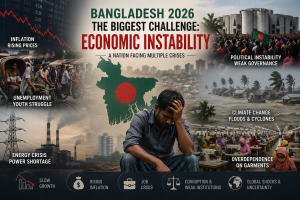


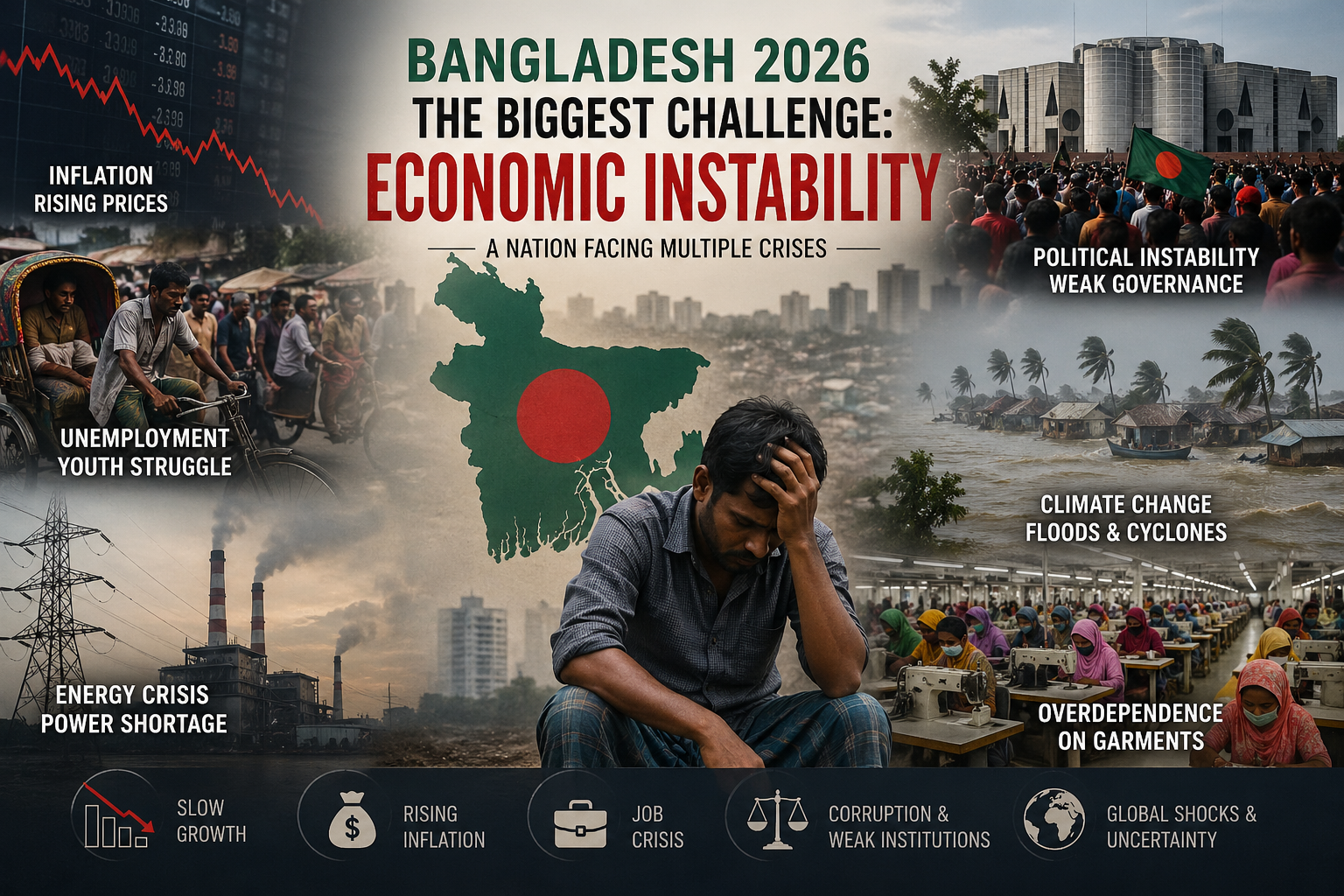
In 2026, Bangladesh is not facing just one problem—it’s dealing with a combination of interconnected crises. But if you ask for the most important, many analysts agree it’s this:
🔴 1. Economic instability (the biggest issue right now)
- Growth has slowed for several years, and poverty is rising again (World Bank)
- High inflation is making daily life expensive (Reuters)
- Investment is weak and jobs are not growing fast enough (FinanceAsia)
- Banking sector problems (bad loans, weak regulation) are worsening confidence (World Bank)
👉 In simple terms: people are earning less, spending more, and opportunities are shrinking.
⚖️ 2. Political instability & governance crisis
- Major political change after the 2024 uprising and 2026 election
- Long-standing issues: corruption, weak institutions, lack of trust (Reuters)
- Past unrest reduced investor confidence and slowed the economy (Institut Thomas More)
👉 Without stable governance, economic recovery becomes very difficult.
👨💼 3. Unemployment (especially youth)
- Large youth population but not enough jobs
- Many educated people remain unemployed (Wikipedia)
👉 This creates frustration, migration pressure, and even political unrest.
⚡ 4. Energy crisis
- Heavy dependence on imported fuel
- Rising global prices increase costs and inflation (The Daily Star)
- Power shortages affect industries and factories (South Asia Journal)
👉 This directly slows business and job creation.
🌍 5. Climate change (long-term but critical)
- Bangladesh is one of the most climate-vulnerable countries
- Floods, cyclones, and rising sea levels threaten millions (Danish Ministry of Foreign Affairs)
👉 This is not just environmental—it affects food, jobs, and migration.
🧵 6. Overdependence on garments industry
- Economy relies heavily on one sector
- External shocks (tariffs, global demand) hit hard (Reuters)
👉 Lack of diversification makes the economy fragile.
🧾 7. Corruption & weak institutions
- Still a major public concern
- Affects business, justice, and public services (Reuters)
🧠 So, what is the most important?
If we simplify everything:
👉 Economic instability is the central problem
Because it connects to:
- unemployment
- inflation
- political unrest
- poverty
And behind that, the root causes are:
👉 poor governance + weak institutions + lack of diversification
Share this content: